
Overview
Scroll to the bottom of the page for a simplified AI Overview of this blog.
What is Beacon?
Vodafone and O2 share network infrastructure across the UK through a programme called Beacon. The UK is split into two main geographic zones. Beacon 1 covers broadly the North, West and Wales and is hosted by Vodafone, while Beacon 2 covers broadly the East and South East and is hosted by O2. Whoever is the host in a given zone has a more complete deployment on those masts compared to the sharer. The sharer typically gets a more limited presence with fewer bands deployed.
The Frequency Problem
Both operators make heavy use of Band 20 (800MHz) and Band 8 (900MHz) for their 4G deployments, and you'll find these across rural, suburban and even city centre masts. But most modern devices sold worldwide and in the EU cannot combine Band 20 and Band 8 together simultaneously in 4G CA (Carrier Aggregation).
The reason manufacturers almost universally skip low band sub-1GHz CA (3GPP Spec CA_8A_20A) comes down to IMD, Intermodulation Distortion. When two frequencies are transmitted or received in close proximity within a small device, they can interact and generate unwanted interference signals at new frequencies, corrupting the very signal you're trying to receive. Band 8 and Band 20 sit close enough together in the frequency spectrum that combining them inside a small phone antenna without that interference bleeding into the receive chain is genuinely difficult to engineer around. It is clearly achievable with the right design and some manufacturers have proven that, but most simply don't bother.
Why Your Beacon Zone Matters
If you're a Vodafone customer in a Beacon 1 zone, Vodafone is the host and is more likely to have Band 8 and Band 20 both present on those masts, making B8+B20 CA genuinely worth having device support for. If you're a Vodafone customer in a Beacon 2 zone, Vodafone is the sharer and typically has a reduced deployment, so Band 8 alongside Band 20 is far less consistent and may simply not be there at all.
The same applies in reverse for O2 customers. In a Beacon 2 zone, O2 is the host and is more likely to have both bands present. In a Beacon 1 zone, O2 is the sharer and you're looking at a reduced deployment where Band 8 may not be present.
The Unwind Exception
In many higher density cities across the UK, Beacon has been unwound. This typically happens in areas where the sharing arrangement simply cannot keep up with capacity demands, so both operators have reverted to their own fully independent deployments on separate masts. In these Unwind areas neither operator is constrained by the sharer arrangement, meaning both have their own deployments in place. This makes B8+B20 CA potentially relevant for both Vodafone and O2 customers in these locations regardless of which operator you're on, and is one of the few scenarios where this combination could benefit you no matter which network you're using. Some examples of unwound areas are London, Birmingham and Cardiff.
Are You Actually Losing Speed?
Yes, in many cases you are. In a large town centre or city you're less likely to notice because there are usually other bands available to aggregate like B1 (2100MHz), B7 (2600MHz) or 5G. But in rural areas, smaller towns and suburban spots where those higher frequencies are sparse, you could be missing out on a 40 to 80% speed boost simply because your phone cannot take full advantage of what the host operator has deployed around you.
How can I tell if my mast has Band 20 (800MHz) and Band 8 (900MHz)? You can use a source like CellMapper to check if nearby masts have these frequencies. A mast with "Bands 8, 20" would be the most beneficial for this, but even masts with other bands like 1 or 7 can still provide a boost to your throughput indoors or on trains where those higher frequencies struggle to reach. By checking CellMapper, you can see exactly where Vodafone is relying on these frequencies and whether your current phone is leaving speed on the table.
So what phones actually support both Band 20 (800MHz) and Band 8 (900MHz) together simultaneously?
| Brand | Model |
|---|---|
| Google Pixel | 7 Series - 10 Series, Pixel Fold 1 |
| Xiaomi | 15 Ultra (Global), 17 Ultra (Global) |
| Sony | Xperia 1 Series, Xperia XZ2, Xperia Pro-I, Xperia 5 III |
| Vivo | X100 Pro (Global) |
| Motorola | Edge 50, Edge 40 Pro |
These are only a few examples of devices confirmed to support the 8+20 combination; this isn't a definitive list.
Beacon Area Map
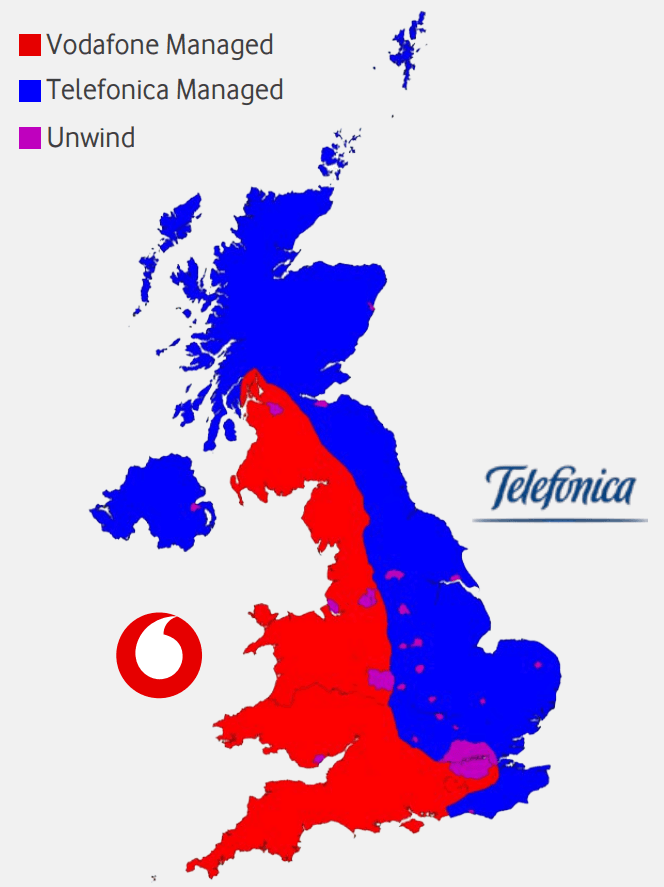
Real-world Examples
The results below demonstrate Band 8 + Band 20 Carrier Aggregation in action. These tests were conducted using a mix of native Vodafone SIMs and various Vodafone MVNOs to confirm the behavior across the board.
While these specific examples were captured within a Vodafone host area, the same technical principles apply to O2. Though we are currently awaiting verified samples from O2-hosted zones (Beacon 2), the hardware requirements and the resulting performance uplift remain identical on paper for O2 customers.


Simplified AI Overview
To put it simply, mobile data travels through the air on different frequencies, which you can think of as separate lanes on a highway. In the UK, Vodafone and O2 heavily rely on two specific "lanes" known as Band 8 and Band 20 to provide coverage in rural areas and smaller towns. While the network is broadcasting both lanes at once, most modern smartphones—including many popular flagships—are only designed to use one of these lanes at a time. Because they cannot "combine" these two lanes into a single, wider path, they often get stuck behind congestion or simply can't move data as fast as the network is actually capable of delivering.
This becomes a real issue because of how these companies share their equipment. In the "Beacon" agreement, the UK is split into zones where one company manages the masts for both. If you are in an area where your provider is the "host," they usually have both lanes wide open and ready to use. If your phone is one of the few models that can actually aggregate, or combine, these two specific lanes, you essentially get a private speed boost. If your phone can't do this, you are effectively leaving a massive chunk of available speed on the table, which explains why two different phones in the same spot can have vastly different download speeds.
Ultimately, this means that your choice of phone hardware is just as important as your choice of network provider. Even if you have "full bars" of signal, a phone that isn't built to handle this specific band combination will always be slower than a compatible model in the same location. By checking if your device supports this "low-band" combination, you can ensure you’re actually getting the performance you’re paying for, especially in parts of the country where high-speed 5G hasn't arrived yet.